
Roger Jones
| A HIERARCHY | First, we view the salient features of these two kinds of organisational structure. |
| A WEB | |
| Some Spectacular Changes | Then we note some recent spectacular successes and failures. |
| A WEB of HIERARCHIES | A capitalist economy has typically been a network of hierachically organised corporations. |
| Some Long Term Business Trends | But many long term trends are changing the balance between large and small organisations and the internal organisation of businesses. |
| A WEB of WEBS | So that the economy becomes a free market in which slimmed down corporations internally emulate market mechanisms. |
| PROBLEMS for INTERNAL MARKETS | There are some problems which limit the effectiveness of internal markets, and hence sustain a disadvantage of large organisations. |
| IMPACT of World Wide Web | And the WWW is an electronic newtork which enhances what can be done by small corporations, increasing competitive pressure on large corporations. |
| THINGS to UNDERSTAND | Thoughts about corporate right-sizing and survival in web-world. |
| CONCLUSIONS | Conclusions, dating fast! |
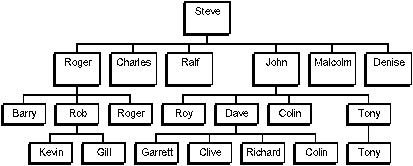

|
Two startling examples of how centralised command structures can fail and how decentralised free initiatives can work are the collapse of the Soviet Socialist system and the extraordinary explosion of activity on the World Wide Web.
This turns inside out our ideas about order and chaos. |
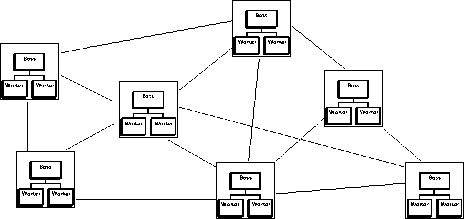
However, this picture has been evolving:
|
Long term trends have been reducing the place of hierarchic command structures in business.
Businesses have been shrinking by procuring more of the services they need on open markets rather than from employees. This trend ultimately leads to the virtual corporation which has no employees. The other trend is towards internal forms of organisation which are less hierarchic and more market-like. These may improve an organisations ability to compete with smaller companies. |
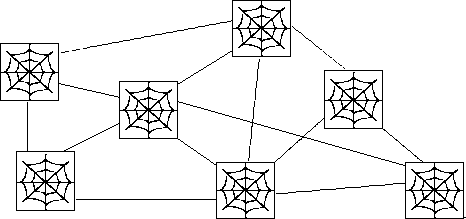
Restructuring of businesses makes the internal structure of the nodes themselves web-like. The economy is becoming a web of web's.
|
Can internal markets enable corporations to operate as effectively as external open markets?
Positioning in the trade-off between security and compensation is significant, and the security embodied in monotonic pay adjustments is an inhibitor to real value pricing of internally sourced services. To offset residual disadvantage it is important to fully realise the advantages of the organisation. Effective knowledge sharing and common culture are important in this area. Internal markets may fail to handle investment decisions effectively, or at all. These decisions may lie outside to the domain of the internal market, or they may be pushed down to units too small to invest for the long term. |
|
The 'information superhighway', at present approximated by WWW, will greatly assist small companies and facilitate the downsizing trend.
This will tip the balance further in favour of outsourcing of services and force the internal organisation of companies to move more rapidly to overcome their disadvantages relative to the external global marketplace. It is not clear how the size advantage of efficient global electronic markets can be resisted. Ultimately we may see virtually all customer/supplier relationships effected by trading over the internet. |
|
These are things to get good at:
Getting the hire/buy/contract decision right is important, and the relative merits of these will be changing rapidly. Getting good at electronic procurement of remotely sourced products and services is important. When deciding whether to internally or locally source you need to know the real cost differentials, which are likely to be large in many cases. The cost differential will be larger for operators who have the necessary skills to use networks effectively, and we will all have to compete with these people. Having contractors physically on-site will become more expensive, and substantial economic value will become attached to the ability to operate an effective globally distributed electronically interworking team. |
|
Anyone whose business is knowledge should think hard about how that knowledge is procured and delivered to the customer.
One-one delivery is extremely expensive relative to any method which permits large numbers to benefit from the knowledge. A rigid compartmentalisation of service delivery and product development will be economically disadvantageous. The range of knowledge based services which can be delivered by computers will be continually expanding, and this will effect what human delivered services and consultancy can be sold. |
 ©
©
 created 1995/6/12 modified 1996/6/25